South Africa’s manufacturing production rose by 0,3% year-on-year in September 2025, according to Statistics South Africa, offering a modest but meaningful signal of resilience in a sector navigating global uncertainty and domestic cost pressures.
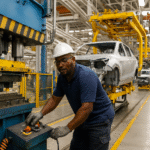
The largest positive contributions came from the motor vehicles, parts and accessories division up 7,6% and contributing 0,5 of a percentage point and the food and beverages sector, which grew by 1,8%, also contributing 0,5 of a percentage point.
While the annual uptick suggests underlying demand strength, the month-on-month picture was less encouraging, with seasonally adjusted production falling by 0,5% compared to August, following a 0,7% rise in August and a -0,9% dip in July.
Quarterly data paints a more stable outlook. Seasonally adjusted manufacturing production increased by 0,1% in Q3 2025 compared to Q2, with four of ten divisions reporting growth.
Notably, the food and beverages division expanded by 1,9% (contributing 0,5 of a percentage point), while the furniture and ‘other’ manufacturing category surged by 8,4% (contributing 0,3 of a percentage point).
However, the wood, paper, publishing and printing division contracted sharply by 5,4%, subtracting 0,6 of a percentage point from overall growth.
On the sales front, September 2025 remained flat compared to August, following a 0,7% increase in August and a -0,4% decline in July. Yet, quarter-on-quarter sales rose by 1,9% in Q3, driven by strong performances in petroleum, chemical, rubber and plastic products (up 3,4%, contributing 0,7 of a percentage point), motor vehicles and transport equipment (2,5%, contributing 0,4), and basic iron, steel, and machinery (1,9%, contributing 0,4).
“This data reflects a manufacturing sector that is holding ground despite structural constraints and global headwinds,” said Peter Mokoena senior economist at a Johannesburg-based investment firm. “The automotive and chemical clusters are clearly outperforming, but the volatility in monthly figures shows how sensitive the sector remains to energy reliability, logistics, and consumer demand.”
The mixed signals underscore the fragile recovery of South Africa’s industrial base. While quarterly gains suggest a slow return to pre-pandemic output levels, the flatlining of sales and the uneven performance across divisions point to persistent vulnerabilities.
For the broader regional economy, sustained growth in manufacturing is essential to job creation, export diversification, and industrial resilience particularly as global supply chains recalibrate around energy transition technologies and shifting trade dynamics.
Looking ahead, analysts caution that load shedding, input cost inflation, and policy uncertainty remain key risks. However, targeted support for high-performing sectors like automotive, chemicals, and food processing could help anchor broader industrial momentum.
As South Africa eyes a more competitive role in regional value chains, the manufacturing sector’s ability to stabilize and scale will be critical to economic recovery and long-term growth.
Read Also:South Africa Targets Saudi Market with Strategic Export Push – Jaina News
South Africa’s Electricity Slump Threatens Regional Stability – Jaina News
Public Sector Spend Surges R41.9bn, Infrastructure Outlook Brightens – Jaina News